Sustainable Screens Scotland: Accelerating a just green transition in the screen industry and beyond
Dr Inge Sørensen, University of Glasgow
RSE Network Grant

The screen industries are significant polluters and contributors to climate change at all stages of the production and distribution process. The practices and production models underpinning the global screen economy precipitate the climate emergency through international mobile production, location shooting across multiple locations, and using disposable props, sets, and consumables.
Dr Inge Sørensen, a Senior Lecturer at the Centre for Cultural Policy Research, University of Glasgow, explains that “To facilitate greener production practices and seek solutions towards a CO2-neutral screen sector, initiatives and certifications have recently been introduced – for example, BAFTA’s Albert Awards and the Green Cinema Toolkit. These schemes are, however, often discreet, disconnected, and seen within the industry as a ‘box-ticking exercise.’ There is, therefore, an urgent need to connect emerging knowledge with the front-line delivery and planning of change within the industry.”
Dr Sørensen and collaborator Dr Mark Wong were awarded an RSE Network Grant (now RSE Research Collaboration Grants) to establish and develop Sustainable Screens Scotland, a network of Scottish film and television, music and festival industries, stakeholders within these sectors, and academics across disciplines to promote the industries’ transition towards net zero.
The Network organised a series of workshops and events that brought together producers, industry stakeholders, and academics with expertise in screen production, cultural policy and economics, public policy, social science, and engineering and environmental sciences. The workshops centred on acknowledged challenges in the Scottish screen industry, addressing these from interdisciplinary perspectives:
Workshop 1: Portable renewable power
This workshop focused on portable renewable power for filming, festivals, and outside events. Findings of the workshop highlighted:
- There is demand for a central resource listing low-impact and carbon-neutral procurement, frameworks, suppliers, and supporting industries, particularly generator and camera rental, facilities, catering, hotels, and transport.
- There is a need for the exchange of experiences across sectors, particularly sharing where new technologies have been effectively applied. This will help build trust in new ways of working and demonstrate efficiency and cost savings.
Workshop 2: A just green transition in the screen sector
This workshop brought together experts from academia, the screen industry, the public/third sector, education and training, and community organisations to discuss what a “just transition” means for the screen industry. Findings of the workshop highlighted:
- Scotland has a powerful narrative and rhetoric that could be more effectively harnessed to be a global driver of change.
- We need to learn from other industries, share best practices, and consider the impacts of the screen sector’s activities on local communities and ecosystems.
- Utilising the power of screen content and storytelling to influence and promote sustainability and a green transition has enormous potential.
Workshop 3: Greening infrastructures and supporting industries
Building on the findings from the previous workshops, a series of invited conversations focused on the common infrastructures and supporting industries that underpin the screen, music, and festival sectors. They explored how these synergies and structures can be combined to accelerate environmental sustainability. These sessions were held in collaboration with Professor Matt Brennan, who was awarded an RSE Personal Research Fellowship to work with Glasgow Life and Creative Carbon Scotland on the project Imagining a just and green future for music cities: The case of Glasgow as a UNESCO City of Music.
Putting the workshop findings into real-world practice and continuing the inter-disciplinary collaboration with Professor Matt Brennan, the Sustainable Screens Scotland Network contributed to a free solar and hydrogen-powered mini-music festival: Dear Green Music Scene.
The festival took place over two stages in St Mungo’s Square, University of Glasgow, with live performances by The Burning Hell, LT Leif, Dora Lachaise, Carla Easton, and Nerea Bello. The event showcased Professor Matt Brennan’s pioneering project, the Phonoautobothy; a solar-powered, mobile music recording and live production studio constructed using upcycled materials.
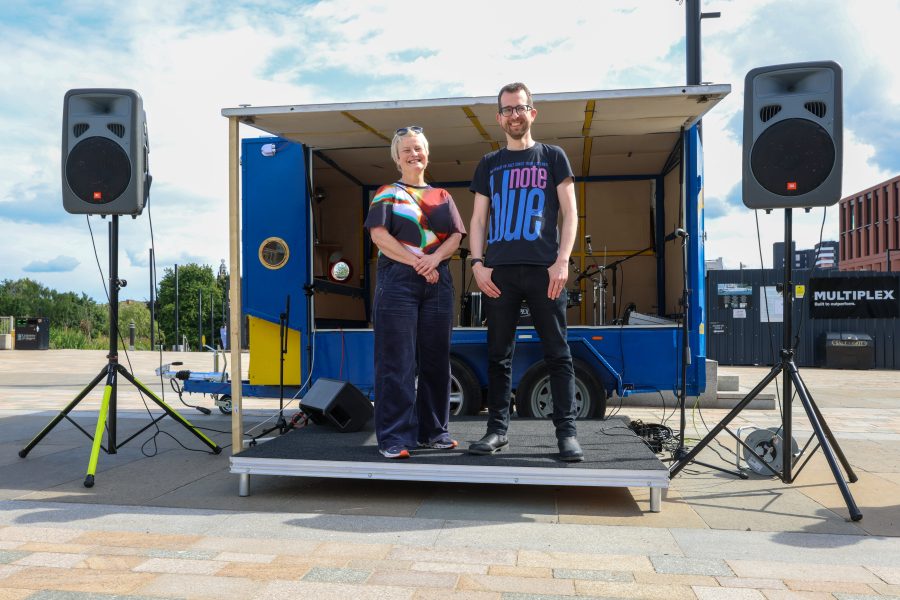
Dr Sørensen commented,
“The RSE award allowed us to bring together a wide range of stakeholders. We consolidated existing collaborations and forged new connections within different sectors; for example, we worked with academics working within sustainability in the music sector, such as RSE Personal Research Fellowship awardee Professor Matt Brennan, as well as major music and festival organisers and companies in Scotland.”
A key finding of the Sustainable Screen Scotland network was the similarities between the infrastructures supporting the film and TV industries and the music and festival industries, and the need to exchange knowledge and collaborate on common structures to support all these industries.
In response, the Network established a Sustainable Screen Scotland database directory of climate experts and experts relevant to Scotland’s music, festival, film, and TV sector. The database allows those in the music, media and screen industries to easily access current sustainability expertise, thereby accelerating the interdisciplinary knowledge exchange required to instil sustainable change in these industries. Academics and professionals in the sector have welcomed the database, which is being used by BECTU, STV, Creative Carbon Scotland, the Scottish Film Commission in Aberdeen, and Screen Scotland.
On what’s next, Dr Sørensen explained that they are working to further their project in collaboration with other academics, Glasgow Life, Creative Scotland, and Climate for Culture.
More details on the findings of each workshop and the festival are detailed here: https://www.gla.ac.uk/schools/cca/research/ccpr/researchinccpr/sustainablescreensscotland/
More about RSE Research Collaboration Grants:

Research Collaboration Grants
Read MoreDesigned to encourage collaborations between disciplines and/or institutions to advance exploration of an important topic.
