The nature crisis will persist unless we tackle the climate-nature emergency with the urgency it deserves
Our climate is changing, and biodiversity is in decline. Scotland has declared nature and climate emergencies, but are these being tackled collectively and urgently? We suggest below that much more needs to be done, requiring more joined-up thinking and coherent action. We explain why we think this is so, suggest what needs to be done, and propose issues for further debate.
|
|
|

A Global Biodiversity Framework (GBF) was adopted during the UN Biodiversity Conference (COP15) in 2022, to which the UK was a signatory. Target 3 of the GBF (30 by 30; Target 3) is that, by 2030, at least 30 per cent of land and water, especially areas of particular importance for biodiversity and ecosystem function, should be conserved and managed effectively. In Scotland, roughly 23% of land and 37% of seas are currently legally protected for nature. On the face of it, this sounds like we might be on track. However, as we point out here, this is not the case. In fact, we are even in danger of going backwards and damaging our biodiversity further by inappropriate or ineffective practices aimed at carbon sequestration.
A very good depiction of all 23 targets in the GBF is given below, adapted from Environment and Climate Change Canada (2024).

Both the UK and Scottish governments have referenced the COP Biodiversity targets and necessary actions. The challenges in meeting these targets are formidable, though of course there are also important opportunities.
How are we faring with conserving biodiversity in Scotland?
In November last year, the Scottish Government published its biodiversity strategy, which sets out its ‘clear ambition for Scotland to be Nature Positive by 2030, and to have restored and regenerated biodiversity across the country by 2045’. The associated delivery plan aims to include ‘actions needed to ensure we are on track to achieving the vision and outcomes in the strategy’. But the current situation is alarming. Scotland’s State of Nature Report (2023) revealed that ‘one in nine (11%) Scottish species are threatened with extinction’, Furthermore, since systematic monitoring of 407 species in Scotland began in 1994, their numbers have declined on average by 15%. For some groups, the situation is clearly even worse; our populations of seabirds and flowering plants have almost halved within the past 50 years. We are not on track in Scotland, hence the need for an ambitious Delivery Plan.
On 19 February 2025 the Natural Environment (Scotland) Bill was introduced to the Scottish Parliament, with the Scottish Government stating it: ‘would place a duty on Ministers to set legally-binding nature restoration targets and will modernise how national parks and deer are managed.’ It noted further: ‘Experts have warned that a decline in biodiversity will make the climate crisis worse while a changing climate will increase the rate of biodiversity loss. The Bill proposes actions to tackle the twin crises of climate change and nature loss with measures to protect biodiversity and reduce harmful carbon emissions.’ Clearly, this is critically important prospective legislation.
Biodiversity targets are being missed across the UK
Other parts of Great Britain are also struggling, even to hold onto what biodiversity we have. In Wales, in January 2025, the Senedd’s Climate Change, Environment and Infrastructure Committee issued a critical report, with its Chair commenting: ‘Wales’ nature is disappearing at an alarming rate’. He goes on to state: ‘Our report looks at how the Welsh Government is responding to the challenge, in particular ’30 by 30’. Our overriding message is that making commitments is all well and good, but this needs to be followed by a clear plan, action delivery and be backed by appropriate investment. All are currently lacking.’ The report’s 30 recommendations make sobering reading. And in England, also in January 2025, an Office of Environmental Protection report states: ‘Progress towards improving the environment has slowed with government still largely off track in achieving its legal environmental commitments.’ Covering the period April 2023-March 2024, the report states: ‘… unless things change materially, key targets, such as the 30 by 30 target for land and sea will not be met.’
On 25 February 2025 the four countries of the UK, coordinated by the JNCC, published the Blueprint for Halting and Reversing Biodiversity Loss: the UK’s National Biodiversity Strategy and Action Plan for 2030. It ties ‘the UK’s commitments, targets and indicators together in an ambitious plan to realise the vision of the GBF.’ Internationally, two days later, the Biodiversity COP16 (which had been held in Colombia in 2024) resumed in Rome to reach agreements ‘on biodiversity finance, on planning, monitoring, reporting and review, and the full set of indicators to measure global and national progress towards implementing the KMGBF, agreed in Montreal at COP 15 in 2022.’ Importantly, this should help generate $200bn a year in nature finance by 2030, essential to deliver effective nature restoration and halt the biodiversity crisis.
Biodiversity and the climate emergency
Coupled with the decline in species abundances, we have the Climate emergency. The Scottish Government was first in the world to declare this formally on 28 April 2019, a day before the Welsh Government did so. And, of course, climate change and biodiversity declines are conjoined, reinforcing crises, as is recognised at local, national and global levels. The UN CBD COP 28 could not have been clearer: “…We affirm that there is no path to fully achieve the near- and long-term goals of the Paris Agreement or the 2030 goals and targets of the Kunming-Montreal Global Biodiversity Framework without urgently addressing climate change, biodiversity loss and land degradation together in a coherent, synergetic and holistic manner, in accordance with the best available science…” — UNFCCC COP28 Presidency, CBD COP15 Presidency, chairs of the undersigned partnerships, initiatives and coalitions, and endorsing member countries (9 December 2023).
Why, even when the UN headlines its advice on Climate Change with: ‘Biodiversity – our strongest natural defence against climate change’ , we seem to be stuttering to even stem the losses of biodiversity? In October 2023, more than 200 health journals urged the World Health Organization to declare the deadly climate and nature crisis as ‘one indivisible global health emergency.’ And on the 6 February 2025 we learned that January ’25 was the warmest January on record, with surface-air temperatures 1.75̊°C above pre-industrial levels, news that came with grave warnings from leading climate experts. Small wonder then that NatureScot’s outgoing CEO, Francesca Osowska, said in January 2025 “it feels as if globally we’re resting on our laurels. Where are the global funding initiatives to support the delivery of 30 by 30, to go beyond, effectively, what is a recovery programme into restoration?”.
There is a rapidly growing body of research outlining the failure to tackle the nature and climate crises; we do not need to rehearse all of this. The inaction, denial, sophistry and downright failure to respond to this genuine environmental and existential crisis is palpable. One gets a sense that only through catastrophic floods, droughts, heatwaves, extreme storms, fire outbreaks, food and water shortages, mass human emigrations, and warfare triggered by any of these, do we get a moment’s attention in the political and media spotlights – before ‘news’ quickly moves on. Indeed, the announcement by BP in late February 2025 that it will cut its investment in renewable energy to focus on oil and gas production, the current attempt to erase climate change from the US research agenda, and the justified fears that the UK Government will overturn the recent landmark ruling by Court of Session in Edinburgh that the consent for the Rosebank and Jackdaw oil field was unlawful, all exemplify our collective failure. How do we break through this and somehow try to make a difference?
Reversing the biodiversity decline
In a Special Issue of the Philosophical Transactions of the Royal Society B. Biological Sciences, published in January 2025, a series of papers explore ‘Bending the curve towards nature recovery’. These arose from a scientific meeting of the Royal Society in London dedicated to and inspired by the outstanding work of the late Professor Dame Georgina Mace. To quote the Dedication by the editors, ‘Georgina championed an inspirational goal of ‘bending the curve of biodiversity loss’. That not only should we slow biodiversity loss, we must also aim for a nature-positive future, to restore a rich and biodiverse planet that can support the health, happiness and potential of current and future generations.’ The 17 papers in the Special Issue reveal the complexity and challenges in doing this, but are understandably light on actual solutions. While it is proposed that Mace’s pioneering ‘people and nature’ approach needs to developed a bit further into a ‘people with nature’ framework, no real path to policy change is proposed; puzzlingly there appears to have been a lack of any formal input into the discussions from government or agency officials responsible for policy. We need to move away from justifying nature conservation using the still prevalent approach of ‘what nature can do for us’. Some of these ‘benefits’ can be replaced by new technologies. Unless we can move away from an exploitative approach to our environment, irreversible biodiversity loss will continue to be the hallmark of the ‘Anthropocene’.
Drawing on these, other studies, notably a key earlier paper on halting biodiversity loss, and recalling the 23 targets of the GBF, we offer five activities which we believe could make a difference, and suggest areas for further debate.
1. Respond to the climate and nature crisis as one, indivisible challenge.
UN COPs and silo government portfolios across single sectors such as environment, carbon emissions, economy, business, health, education and every other area of government activity need to coalesce into one front. Dr Anne Sénéquier, working at the French Institute for International and Strategic Affairs (IRIS), reflected on the 2024 Climate COP 29 and Biodiversity COP 16, noting these ‘… highlight a fundamental paradox in global environmental governance: the persistent separation between processes that aim to address crises that are inherently interconnected.’
Three UN Convention Executive Secretaries combined forces to urge the alignment of efforts ‘to ensure planetary health’. Unambiguously, they stated: ‘By 2030, we must cut greenhouse gas emissions by at least 43% compared to 2019 levels to keep global warming to 1.5°C above preindustrial levels, while boosting climate resilience. We must conserve 30% of land, waters and seas and restore 1.5 billion hectares of degraded land by 2030.’
Multiple policy areas have an impact on biodiversity in Scotland: agriculture, forestry, fisheries, the need to support rural economies, housing needs, energy needs. But policies set in one sector can do damage elsewhere – an exemplar is commercial forestry practice in Scotland, mooted as supporting Carbon sequestration targets, whilst actually doing so poorly, to the detriment of biodiversity, and at considerable public expense.
Key issues for debate
- Are Scottish Government portfolios fit to support conjoined action on climate and nature? A related RSE blog discussed the importance of breaking down silos in environmental governance in Scotland.
- How can much greater connectivity between social/health, economic/enterprise and environmental domains be achieved to genuinely devise and enact solutions to this planetary and humanity crisis?
- Related to this, should the UK Government be arguing for all three COPs to be merged as desertification, biodiversity and climate are intimately linked.
- How do we get people to understand the tragedy of human driven species extinction and care about the future of other species?
2. Act on the indirect as well as direct drivers forcing the crisis.
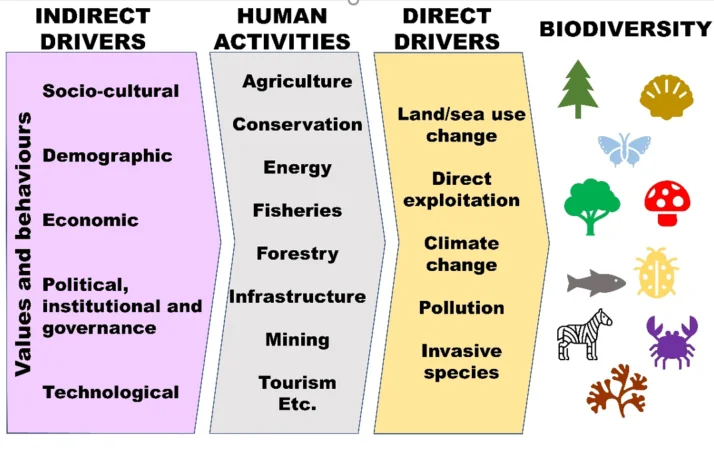
Degradation and overexploitation of nature massively contributes to increases in greenhouse gas emissions, coupled with sustained reliance on fossil fuels, and pollution. These and many other drivers are ‘directly’ impacting, but it is the underlying ‘indirect’ forces we need to work with – power, wealth sharing, financing, understanding, communicating, and adapting are all necessary elements that drive the drivers. This NatureScot report on work led by The James Hutton Institute is an important and comprehensive overview of why we need to work with the indirect drivers. The infographic below is taken from a NatureScot briefing on the report.
Key issues for debate
- How do we change the way government and society work to connect the indirect and direct drivers through the range of human activities referenced above?
- Are government and agencies functioning in a way that ensures the right levers are pulled – rather than operating as a mishmash of activities?
- How can existing frameworks for e.g. fisheries, renewable energy, timber production and food security be revised to influence indirect and direct drivers of the nature-climate crisis?
- How can we ensure that effective action is taken against invasive species, native as well as non-natives?
- Given the excellent content in the NatureScot/JHI report on indirect drivers, how do we ensure the recommendations are acted on?
3. Restore nature at scale, and ensure the evidence base is robust.
In the lucid report ‘Making space for nature: A review of England’s Wildlife Sites and Ecological Network’ published 15 years ago, Professor Sir John Lawton articulated the principle of making networks of wildlife sites ‘bigger, better and more joined up.’ This fired the imagination and activities of a groundswell of national and local bodies to think and operate at scale, and devise appropriate policies. As recently as January 2025, the largest conservation body in the UK, the National Trust, marked its 130th anniversary by announcing ambitious plans to create 250,000 hectares of nature-rich landscape across England, Wales and Northern Ireland. It is now widely recognised that working at large scale, cooperatively involving scientists, landowners, managers, communities and policy makers, offers the best chance for nature restoration, resilience and enrichment. In Scotland, the partnership ‘Cairngorms Connect’ is an example of how bold progress might be achieved in the medium term.
The evidence base is critical in supporting the narrative and effort on restoration, with some recent overviews pointing directly to the importance of this. The Nature Positive Initiative, a global enterprise, is directing work to ‘reach consensus on credible, practical metrics to measure nature-positive outcomes.’ The remarkable efforts by Bill Sutherland and others to make conservation actions and policies evidence-based via the Conservation Evidence platform is providing a key resource to make this possible.
Key issues for debate
- Have we a sufficiently robust evidence base to point to where key action is sufficient already or needed more?
- We need a much better balance between expectations of economic growth and impacts on nature. Can we include in measures of growth an increase in nature restoration?
- Should a precautionary principle be the key part of policy development rather than uncertainty being used to justify inaction?
- It is notoriously difficult to turn science into policy. How can we improve the science-policy interface in Scotland?
4. Emotional and inspirational connections.
If communities from global to local are not rallying to quite literally save the planet something fundamental is wrong. By ‘communities’ we embrace the UN, NATO, G7 through regional and national states, to councils and community councils. At each of these levels there is fundamental detachment from planet to conscience which is halting progress. We need to nurture the relationship between people and nature so that people view themselves are a part of nature, rather than apart from it. Locally, personal contributions to nurturing nature and society can be immense. Several important commentators have touched on this, noting the absence of ‘the power of emotions’. The UNESCO Research Institute MGIEP provides a significant resource on the evidence base underlining the importance of emotional drivers as well as the educational materials and methods which are so important. The evidence base is growing on the importance and untapped potential of emotions in contributing to sustainable behaviour changes which support broader work on environmental sustainability.
There are plenty of strategies, policy papers and briefings on embedding sustainability and climate change in children’s education, such as in England and Scotland, but the sense of urgency is not palpable. Genuinely engendering a sense of connection with nature through physical, intellectual and emotional ties is powerful. Cultivating an eagerness to learn about earth cycles and processes is surely a powerful means of making genuine progress in the raising the bar on nature consciousness.
Key issues for debate
- Given nature-climate emergencies are declared, how can society at all levels be persuaded to behave responsibly to deal with them?
- How do we break through the evident blockage in human consciousness and political action to avoid what is evidently an environmental catastrophe in the making?
- Can we better tool up our Education Sector to support the upcoming generations who are inheriting the growing crisis?
5. Nature-based Solutions (NbS).
Much of what we describe above could come under the heading of NbS. There are institutes and journals devoted to the topic of NbS. The IUCN states ‘Nature-based Solutions (NbS) are a powerful way to address societal challenges, such as climate change, biodiversity loss, and food security. As the world strives to move towards the UN Sustainable Development Goals, we must ensure that investments in nature contribute to the health and well-being of people and the planet.’ Its ‘Global Standard’ (2020) guides users to design and implement NbS in a way that allows nature to deliver its valuable ecosystem services.
A recent paper in Nature helpfully reviewed the seven major social challenges at the heart of tackling the nature-climate crisis, and identified a relative dearth of work on economic/social development, human health, and food/water security. NatureScot provides many examples of NbS in Scotland. These give great hope for a much more concerted approach for us to be part of rather than apart from nature.
Under the broad NbS heading, some immediate concerns need to be addressed. The consequences of slow/inadequate responses to non-native invasive species can be both environmentally catastrophic and costly – the invasion of a small number of non-native stoats, Mustela erminea, on Orkney has required a multi-million pound response project. Overall, the annual cost of non-native species control has been estimated to be £200 million in Scotland (and £1.9 billion across GB). Sitka spruce (Picea sitchensis), accounting for at least half of Scottish commercial plantations, was first recorded in the wild in Britain in 1957, yet according to Plant Atlas 2020 it has shown the most significant increase in range of any plant species (of 3,445 plant species recorded during Plant Atlas 2020 fieldwork, 1,753 non-natives were found to have been deliberately or accidentally introduced into the wild by humans).
Under the IPBES Report, direct exploitation of species is one of five key drivers. In Scotland the exploitation of ‘game’ species feature prominently in resolving conflicts of interests and sustainable land use, and have required new (for red grouse, Lagopus scoticus) or further proposed (for red deer, Cervus elaphus) legislation. Regulation is an extreme example of a NbS, and points to failure of sustainable land management. Globally, growing evidence points to land and sea use being the principal driver of biodiversity loss, with direct exploitation of natural resources ranking second. This overwhelmingly points to the need for key investment in NbS.
Key issues for debate
- How can we improve the science-policy interface in Scotland?
- Are our current government structures in the environmental area fit for purpose?
- Given the persuasive evidence on the effectiveness of NbS in tackling e.g. flooding, drought and erosion, why is there so much reluctance to implement them in existing government funded programmes and projects? Why are existing powers not fully exercised (e.g. in relation to red deer, Cervus elaphus control)?
- Should every development proposal in Scotland include a compulsory NbS element?
- Why are some highly invasive species that demonstrably damage natural habitats and reduce biodiversity (such as Sitka spruce, and pheasants, Phasianus colchicus) not classified as an invasive non-native species?
- Are there sufficient ‘polluter pays’ principles to reduce heavy reliance on public funding for the control of non-native invasives?
- Are the scientific advisers and practitioners sufficiently drawing on earth, biological, engineering and social competencies to achieve holistic NbS?
There are many other activities that would make a difference, but this is our starter for five. Given the UK and Scottish governments have declared a climate emergency and a nature crisis, let’s pull out the stops to avert a disaster.
- This article is part of a series from the RSE’s Environment Community of Interest. The aim is to stimulate informed public debate on the many aspects and elements of this complex and vexed subject. We’d love to hear your thoughts about this piece, email us on publicpolicy@theRSE.org.uk.
- To be notified when the next article in this series is live, sign up to the RSE’s monthly policy advice newsletter.
- The RSE’s blog series offers personal views on a variety of issues. These views are not those of the RSE and are intended to offer different perspectives on a range of current issues.
