Joyce Tait writes about the role of bio-based manufacturing, engineering biology and industrial biotechnology, in driving environmental benefits in the UK. With adaptive governance systems, these technologies are crucial in replacing fossil fuel-based manufacturing with more sustainable processes, contributing to net zero, and biodiversity goals.
Professor Joyce Tait FRSE
The role of bio-based manufacturing in delivering environmental benefits
Technological innovation is widely being promoted by governments as the key to creating economic growth and driving prosperity. Engineering biology and industrial biotechnology are recognised as an important part of that landscape[1]. The term engineering biology (EB) covers the basic science platform, pushing the boundaries of new genetic technologies and related sciences, creating transformatively innovative products across a broad range of sectors of the economy; and industrial biotechnology (IB) covers the manufacturing processes, mainly involving large scale fermentation, delivering EB products to markets.
This push for growth fuelled by technological innovation is accompanied by a UK Government review on Pro-innovation Regulation of Technologies[2], led by Sir Patrick Vallance and the current Chief Scientific Adviser Dame Angela McLean, in recognition of the important role played by regulatory systems in determining which technologies will be able eventually to reach a market place and contribute to the economy.
In addition to their role in the growth agenda, EB and IB will play a major role in delivering environmental benefits and meeting UK sustainability policy commitments. They are making it possible to replace conventional fossil fuel-based manufacturing with processes based on microbial fermentation or plant or animal-based production, contributing to Net Zero related policies[3]. Also, bio-based production systems typically use less energy and create less pollution than their conventional counterparts and, in many cases, they can also deliver significant biodiversity-related benefits. Where they are able to use waste products or by-products from other industries as feedstock for bio-based manufacturing, they can also contribute to a circular bioeconomy[4].
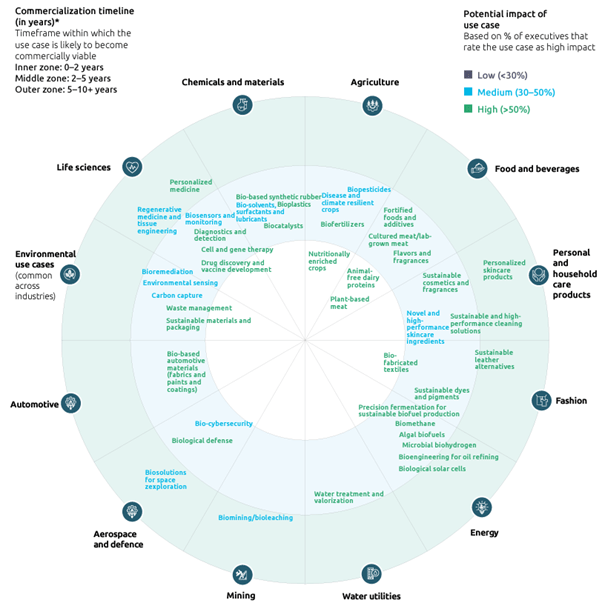
EB and IB are expected to have environmentally relevant applications in many industry sectors. In a survey of 1,100 senior executives from large companies and 500 from small and medium sized companies, 96% were already pursuing bio-solutions; 72% believed that bio-solutions can significantly accelerate progress towards sustainability goals; and they are preparing to harness these benefits and navigate the expected disruption to their business models. However, 53% of the SME executives in this survey pointed to regulations that are not fit for purpose as barriers to the development and scale-up of biotechnology-based innovation, including regulatory complexities and fossil fuel subsidies. The executives came from a broad range of sectors: medical life sciences, chemicals and materials, agriculture, food and beverages, personal and household care products, fashion, energy, water utilities, mining, aerospace and defence, and automotive[5].
Figure 1. Impact and commercialisation timelines for engineering biology use cases – by industry (see Note 5)
*Commercialization timelines are based on the assessment of surveyed executives and Capgemini experts. Source: Capgemini Research Institute analysis; Capgemini Research Institute, Engineering biology survey, April–May 2024, N=1,100 corporate organizations.
To sum up, EB and IB will have a major contribution to environment-related policies such as Net Zero and biodiversity, at the same time reducing the pollution and energy demands associated with the industrial processes they will be replacing. However, to make the best use of this opportunity, we will need more agile approaches to the promotion, regulation and governance of the various technologies if they are to deliver the expected impact on carbon dioxide levels and biodiversity at a significant scale and on a useful timeframe. Scotland is well-placed to take advantage of this opportunity, particularly through the network of researchers, companies and collaborating organisations orchestrated by the Industrial Biotechnology Innovation Centre (IBioIC).
An example: single cell protein for animal feed
The opportunity
Fish farming has a potential to reduce the carbon dioxide and methane emissions associated with farming to the extent that fish replace beef and sheep meat in people’s diets. Fish can also provide a healthy diet for those who currently lack sufficient access to protein. However, at the same time, fish farming has a history of causing ecosystem damage and biodiversity loss and there is an urgent need to address these challenges. A study analysing the range of climate-related and biodiversity impacts of salmon farming, and the potential of innovative technologies to address these problems, noted that aqua-feed accounts for over 90% of fish farm-gate greenhouse gas emissions, land use, water use and energy use. It is also the most expensive component of aquaculture production. The study concluded that innovation in feed production has the greatest opportunity to contribute to fish farming’s climate change mitigation and to improve biodiversity-related impacts[6]. The report also concluded that successful approaches to developing sustainable feed products for aquaculture are most likely to come from EB and IB innovations, including single-celled protein (SCP) from micro-algae, yeasts, bacteria and fungi.
IB value chains in single cell protein development
Like many other IB products, in developing a SCP product, the pathway from the basic research idea and proof-of-concept to a final consumer market will involve a series of business-to-business transactions along a value chain (Figure 2, see Note 4). The SCP product, based on gas fermentation using hydrogen and carbon dioxide as raw materials, is the final output for the innovative biotechnology company at the beginning of this value chain. The SCP product will then undergo a series of business-to-business transactions, involving feed testers, feed producers, farmers, food processors and finally retailers where the fish product will be bought by consumers. At each transition it will come up against different incentives and barriers to its progression to the next point in the value chain, often in the form of regulations, standards and government policies, and the more disruptive it is for the business models of the incumbent companies the more such barriers are likely to be manipulated either to hinder or to support its progress[7].
Also, the more disruptive the innovative product, the more it will struggle to conform with the demands of the existing governance or regulatory systems for that industry sector, potentially leading to abandonment of the innovation or diminishing of its economic competitiveness or its environmental benefits. As described in Section 3, The PAGIT Framework, developed by the Innogen Institute with support from the British Standards Institution and the ESRC, charts a route to managing these complex challenges and is being adopted for a range of different technologies and business sectors, including through the work of the UK Government Regulatory Horizons Council[8].
Figure 2. Value chain for SCP production
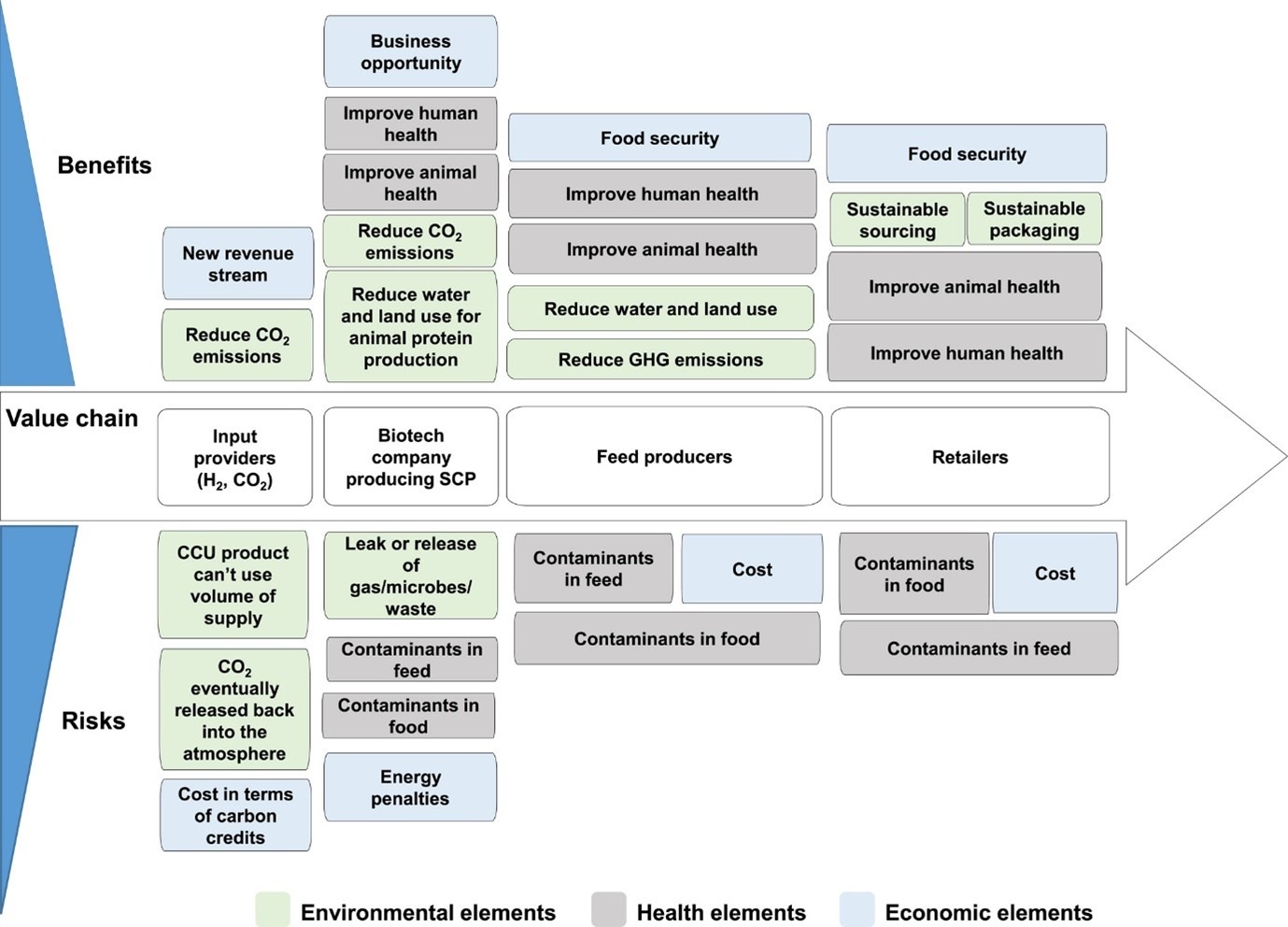
The value of the innovation, and the incentives and barriers to its production and use will also be perceived differently by the different players along this value chain (Figure 3)[9].
Figure 3. Perceived risks and benefits of the production and use of SCP
Proportionate and adaptive governance of innovative technologies (PAGIT)
In general, across all bio-based sectors of the economy, regulations and standards are an important factor in either enabling or discouraging the development of innovative products and services. Since 2002, the Innogen Institute in the University of Edinburgh has been analysing case studies and collecting data on the regulatory barriers to innovation in life sciences, the extent of their impact and how they could be addressed, i.e. how regulatory systems could be adapted to make them more proportionate to the benefits and hazards of innovative products based on new genetic technologies, including engineering biology, synthetic biology and gene editing. We found similar types of problematic interaction between life science-related innovation and the governance systems to which its products are subject, across a broad range of industry sectors, including agricultural crops, farm animals, drug development, biofuels, stratified medicine, regenerative medicine, diagnostic devices and industrial biotechnology. In the context of this paper, this amounts to a drag on the potential of EB and IB to deliver significant environmental benefits by contributing to Net Zero and biodiversity-related government policies, and a waste of the public money invested in the basic scientific research.
This research, and representations from innovative companies, have led to a growing realisation, in political and policy circles, of the need for change in the regulatory and governance systems that were developed for the products of twentieth century technologies and are no longer compatible with the properties of the products coming from today’s transformative technology platforms, such as engineering biology, AI and quantum technologies. However, until recently, the prevailing view among regulators has been that it is unacceptably complex and time-consuming to change a legally-based regulatory system. The only option has been for innovators to adapt their products to the needs of the prevailing regulatory system, often meaning that potentially useful and safe innovations were never developed.
This impasse led to the development of the PAGIT framework[10], building on the improved understanding in the Innogen Institute of the interactions between regulators and innovators, and supporting better governance decision making by companies, regulators and standards bodies that is more adaptive to the properties of today’s innovative technologies. The elements of the PAGIT framework that are relevant to engineering biology and industrial biotechnology include the following:
Building a good reciprocal understanding between innovators and governance actors of the changing nature of products, their properties and capabilities, and the governance-related challenges they will face, as they pass from basic scientific research to products on the market;
Using this understanding to encourage governance actors, both to explain clearly to innovators the requirements of governance systems, and to be willing to adapt these requirements more directly to the needs of the innovative technologies;
In the early stages of product development, to avoid resorting prematurely to legally-based regulation (‘hard law’), using standards and guidelines (‘soft law’) to ensure product safety, quality and efficacy; and in the later stages of product development, only resorting to regulation if this can be justified by evidence;
The need for technology developers to adopt a responsible innovation approach, particularly where products are likely to be disruptive of incumbent company business models.
This framework contributed to the UK Government White Paper on Regulation for the Fourth Industrial Revolution[11] which set up an independent expert committee, the Regulatory Horizons Council (RHC)[12], to identify the implications of technological innovation and provide government with impartial advice on the regulatory reform needed to support its rapid and safe introduction. Relevant to this paper, the RHC has produced two reports, on modified plants and animals[13] and on engineering biology[14], both advising on how to deliver more proportionate and adaptive governance of products in these areas, and to do so on a more rapid timeframe. The RHC also found that the PAGIT Framework was equally applicable to the governance of quantum technologies[15].
This framework is continuing to be applied and adapted through the work of the Regulatory Horizons Council and the newly created Regulatory Innovation Office (RIO). To the best of our knowledge, this is the first initiative of its kind internationally and there is a need for its implementation to be informed by future case studies designed to extend and capture the knowledge base on which it relies, and to support its transformation, for example to the governance of innovative services and policies.
The Scottish context
The UK government has embraced the need for greater emphasis on support for the innovation process itself in our overall governance of innovative technologies, including for engineering biology and industrial biotechnology and the UK as a whole is well placed to capitalise on this opportunity (see note 2).
Relevant initiatives in Scotland include the IBioIC Net Zero Accelerator[16], delivering greener manufacturing and climate-friendly products through the Engineering Biology Centre in Edinburgh, scale-up facilities in Edinburgh and Glasgow, the Net Zero Accelerator Pilot plant in Grangemouth and the Grangemouth Sustainable Chemicals Campus Cluster. IBioIC also produced the 2022 update to the Scottish National Plan for Industrial Biotechnology, with increased targets for the number of active IB companies, number of employees, and the turnover of these companies given that, by 2020, Scotland was well ahead of schedule to achieve the 2025 targets (Table 1)[17].
Table 1. IBioIC, updated stretch targets Scottish National Plan for Industrial Biotechnology [17]
State of play in 2013
Original targets for 2025
State of play in 2020
New targets for 2025
Companies actively involved in IB
43
200
147
220
Estimated turnover
£189m
£900m
£797m
£1.2bn
Direct employees
1,103
>2,500
>3,000
>4,000
GVA contribution
£61m
>£250m
>£235m
>£360m
However, in this National Plan there is no recognition of the importance of supportive regulation and governance systems (i) in determining the attractiveness of a country as a location for investment, and (ii) in determining how well companies based in a country will thrive in the long run. This seems to be a long term, general weakness in the attention the Scottish Government gives to regulatory and governance issues and how they relate to Scotland’s innovation potential more generally, and there might now be better opportunities to change this given recent changes in the governments of Scotland and the UK.
This article is part of a series from the RSE’s Environment Community of Interest. The aim is to stimulate informed public debate on the many aspects and elements of this complex and vexed subject. We’d love to hear your thoughts about this piece, email us on publicpolicy@theRSE.org.uk.
The RSE’s blog series offers personal views on a variety of issues. These views are not those of the RSE and are intended to offer different perspectives on a range of current issues.
[4] Tait, J., Raybould, A., Flight, M.H. and McGoohan, A. (2023). Circular and Networked Bioeconomies for Net-Zero Food Production: There is Nothing Magic about Circles. Circ.Econ.Sust. https://doi.org/10.1007/s43615-022-00247-w
[7] Tait, J and Wield, D. (2019) Policy Support for Disruptive Innovation in the Life Sciences. Technology Analysis and Strategic Management, 33:3, 307-319. https://doi.org/10.1080/09537325.2019.1631449
[9] Monica Hoyos Flight et al., (2024). Analysing Responsible Innovation along a value chain – a single-cell protein case study. Engineering Biology. ID: ENB2_12031; https://DOI.org/10.1049/enb2.12031
We use cookies on this website. By clicking “Accept”, you consent to the use of these cookies.
Functional
Always active
The technical storage or access is strictly necessary for the legitimate purpose of enabling the use of a specific service explicitly requested by the subscriber or user, or for the sole purpose of carrying out the transmission of a communication over an electronic communications network.
Preferences
The technical storage or access is necessary for the legitimate purpose of storing preferences that are not requested by the subscriber or user.
Statistics
The technical storage or access that is used exclusively for statistical purposes.The technical storage or access that is used exclusively for anonymous statistical purposes. Without a subpoena, voluntary compliance on the part of your Internet Service Provider, or additional records from a third party, information stored or retrieved for this purpose alone cannot usually be used to identify you.
Marketing
The technical storage or access is required to create user profiles to send advertising, or to track the user on a website or across several websites for similar marketing purposes.