The role of the quality infrastructure in scaling net zero
The report highlights several ways quality infrastructure can support innovation and accelerate progress towards net zero.
Download the role of the quality infrastructure in scaling net zero report (403KB, PDF)
The British Standards Institution is hosting the International Electrotechnical Commission’s (IEC) annual meeting, on behalf of the UK, in Edinburgh in October 2024. In its efforts to engage with local stakeholders to create an impactful legacy for the conference, the BSI commissioned the Royal Society of Edinburgh (RSE) to bring to bear the world-leading expertise of its multidisciplinary Fellowship and Young Academy of Scotland to examine the role of quality infrastructure (QI) in accelerating progress to net zero.
Quality infrastructure (QI) refers to the institutions in every country which manage the core functions that underpin the market economy: measurement, standards (assurance), and accreditation. Despite being ubiquitous, in many countries – including the UK – the QI is largely invisible, with a low level of awareness or understanding amongst government, industry, and consumers. If we are to reach net zero by the deadlines that loom ever nearer, scaling up novel technological solutions will be a critical factor to our success. QI can pave the way by speeding up and harmonising the necessary governance, helping to take promising innovations out of the lab and into the global marketplace in time to make a real difference.
The QI can support innovation in several ways:
Securing business and innovative advantage through standards
While nations can be obliged to incorporate international standards within their own regulatory frameworks (such as entrenching the principles of the Paris Agreement within corresponding national targets), they can also influence standards upstream by participating in international negotiations where prospective standards are scrutinised and ratified. In doing so, nations can ensure their economic and industrial interests are reflected in these emerging standards.
Standards as an alternative to regulation
Given the timescales required to introduce or amend laws, developing regulatory systems is by default a protracted process. Stakeholder-led standards can provide an adaptive alternative to regulation that allows for regular recalibration as more evidence becomes available. They can thus evolve alongside the products, practices, and services they are intended to oversee.
Flexibility
In the last ten to fifteen years, there has been a noticeable trend towards more agile, responsive standards. This agility can be capitalised on to fast-track solutions to key societal challenges like net zero. For example, the newly introduced ISO Net Zero Guidelines were developed through a formal international workshop process involving over 100 countries and over 1,200 people in record time – four months – illustrating the potential for standards to be developed rapidly without sacrificing rigour. BSI has implemented fast-track processes for many years that are widely used by government and industry.
Securing consumer, industry, and investor trust
The QI transcends political short-termism and provides an enduring link to global markets and the wider economic picture that cannot be undone through changes in domestic policy. This ensures that innovation continues to be incentivised and rewarded. Through procurement, governments can act as consumers and their outgoings can be significant. Given this huge volume of investment, it becomes particularly critical to ensure that appropriate standards are applied to the public procurement of goods and services, including sustainability standards. Consumers are also seeking and indeed deserve peace of mind that the investments they make in green solutions will pay off, both from a financial as well as an environmental perspective. By having the appropriate standards in place, consumers can be assured that new technologies are not only safe and effective, but that they will remain fit for purpose over a reasonable timeframe. Elevating the consumer voice is becoming an increasingly central concern within the standards community. The UK is already regarded as an exemplar in involving consumers in the process of setting standards, and the national quality infrastructure (NQI) is further improving their representation.
Despite the economic, societal, and environmental benefits that can be derived from using QI to its full potential, there remain challenges to applying it to the innovation space.
Lack of awareness
Stakeholders may not even be aware that QI exists. For those that do, they may not fully understand how it applies to them and how to engage with the system confidently and strategically. Government and public agencies may be similarly unacquainted with all the nuances of the standards space, particularly those which are new or emerging.
Industry reticence
When developing or adapting standards, it can be difficult to achieve the necessary consensus, particularly in industries where a few vocal players exert a disproportionate influence on the direction of the sector. Indeed, there can be a strong reluctance among incumbents to accept new standards that threaten to disrupt their business models or whose return on investment is not immediate. Environmental and social standards can often fall into this category of delayed returns.
Applying systems thinking to standards Developing a system of standards and assurance to govern a particular product, practice, or service can introduce a dilemma: is the optimum solution one that governs the technology itself, or one that covers the overall market framework where that technology is deployed? If a new product is rolled out in accordance with the latest standards, we must ensure that industry is ready to receive it and that its introduction will not lead to any unintended consequences as far as we can tell. Although systems thinking can be a challenge, it is important for the standards community to face it head on. It would also help to remedy the fragmentation that is often observed across Scotland’s policy environment, providing another example where standards may be more suitable than legislation in governing innovation.
Case studies are presented to show how QI has been successful in promoting innovation and where it could be made more adaptable. The case studies are derived from the following sectors and contexts:
- The built environment
- Regulatory equivalence
- Wind energy
- Water
- Hydrogen
- Consumer rights
The paper concludes by offering recommendations for future action and improvement.
Improving visibility of QI and signposting to resources
Businesses and public bodies may not understand how to harness QI to improve their performance and bottom line, particularly smaller organisations. Start-ups and Small and medium-sized enterprises (SMEs) could benefit from accessing road maps or guidance documents (whether generic or industry-specific) that explain how to leverage QI for the purposes of innovation and growth.
Capacity building
As QI looks to raise its profile, it should also consider how it can support the development of associated training opportunities, perhaps in partnership with universities, research institutions, and standards bodies like the BSI. Such training would ideally cover not only the mechanics of QI (including their intersection with international schemes), but it would also explain how to engage constructively with the standardisation process itself.
Making standards more agile and adaptive
QI can act as a powerful tool to galvanise international progress towards net zero. However, the system needs to become even more forward-looking and adaptable than it is today. Society cannot conceive of all the solutions that will ultimately be deployed in meeting the climate change challenge and so QI must be able to deal with unanticipated opportunities or hazards. Indeed, standards should be as much a proactive as a reactive tool, one that complements its reputation for effective monitoring and evaluation with greater openness to dynamic experimentation. In this way, standards can form part of a feedback loop that both transmits and collects information, implementing proportionate expectations while also pointing to areas for improvement and helping to suggest a future direction of travel for the sector being considered.
As with regulation, prescriptive, technical standards can serve a valuable purpose, most often in the field of consumer products where safety is paramount and predicated on absolute clarity. Similarly, standards that are too broad run the risk of being inefficient if they are too superficial to accommodate the properties of the technologies they are meant to encompass. New or emerging practices and services can benefit from using a framework of process or outcome-driven standards which focus on performance requirements rather than prescriptive technical specifications.
Where new standards are developed, or existing ones adapted, to deal with the properties of innovative technologies, they will need to have a solid grounding in regular engagement with sectoral innovators and policy makers, citizens and consumers. This engagement should take place at both national and regional levels.
Contributors
- Professor Joyce Tait FRSE
Director, Innogen Institute, University of Edinburgh - Dr Scott Steedman CBE
Director-General, British Standards Institution (BSI) - Professor Iain Docherty FRSE
Dean of the Institute for Advanced Studies, University of Stirling - Professor Muhammad Imran FRSE
Dean of Transnational Engineering Programme, University of Glasgow - Professor Andy Kerr FRSE
Director, UK & Ireland, EIT Climate-KIC - Professor Gordon Masterton FRSE
Professor Emeritus of Future Infrastructure, University of Edinburgh - Dr Simson McCreath
Senior Product Development Scientist, Terumo Aortic and Young Academy of Scotland - Mr Douglas Morrison
Deputy Chief Executive Officer, Built Environment-Smarter Transformation and Young Academy of Scotland - Professor Raffaella Ocone FRSE
Professor of Chemical Engineering, Heriot-Watt University - Dr Louise Reid
Senior Lecturer in Sustainable Development and Geography, University of St Andrews and Young Academy of Scotland - Mrs Angela Scott FRSE
Founder, TC BioPharm Scotland - Mr Lewis Shand Smith
Chair, Energy Consumers Network - Professor Stephen Skinner FRSE
Ceres Power/RAEng Research Chair and Professor of Materials Chemistry, Imperial College London - Professor Andrew Tyler FRSE
Scotland Hydro Nation Chair, University of Stirling - Dr Ritwika Sengupta
Net Zero Policy Manager, BSI
Launched at the IEC annual General Meeting in Edinburgh
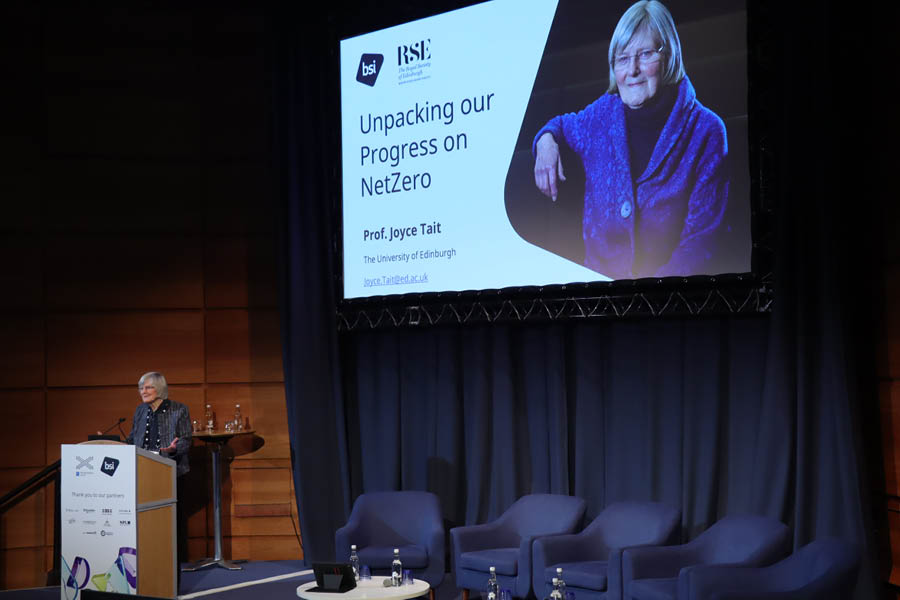
This report was launched at the International Electrotechnical Commission (IEC) annual General Meeting in Edinburgh which ran from 21 to 25 October 2024 and was hosted by BSI.
The IEC is the world’s leading organisation for the preparation and publication of international standards for all electrical, electronic, and related technologies. Over 1,500 stakeholders, each experts in their various fields, attend the week-long General Meeting to discuss standards innovation across a wide range of key sectors, such as climate action, healthcare, smart manufacturing, AI, and transport.
It was the first time this annual event has been held in the UK for 35 years and offered an excellent opportunity to promote Scottish innovation in fields such as sustainability, innovation, and smart cities.
In its efforts to engage with local stakeholders to create an impactful legacy for the conference, the BSI commissioned the RSE to bring to bear the world-leading expertise of its multidisciplinary Fellowship and Young Academy of Scotland to examine the role of quality infrastructure (QI) in accelerating progress to net zero, inspiring the collaboration that led to the production of this paper.
Download this policy advice
Download the role of the quality infrastructure in scaling net zero report (403KB, PDF)
