Royal Charter
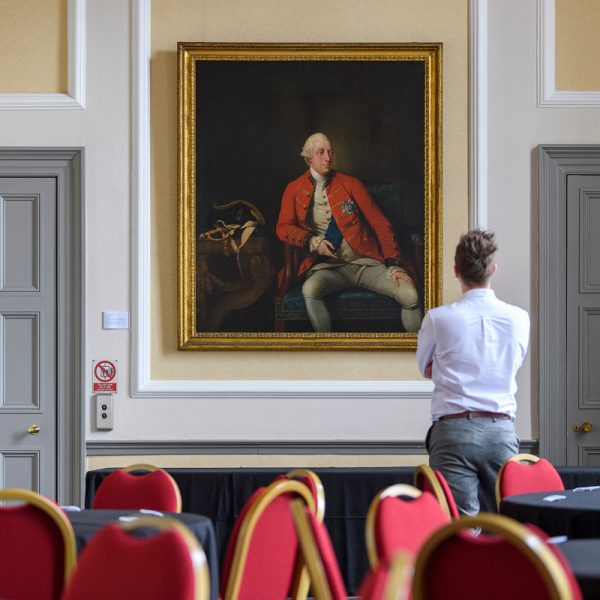
The founding RSE Royal Charter was granted in 1783 by King George III and states that the object for which we are constituted ‘for the promotion of letters and useful knowledge’

In November 1782, a petition was made to King George III for a ‘Royal Society of Edinburgh for the Advancement of Learning and Useful Knowledge’, which was granted on 29th March 1783 – with the first meeting of the RSE convened on 23 June 1783. In the words of one of its prime movers, William Cullen, professor of the Practice of Physic in Edinburgh University, the new society was to comprehend: “not only medical science, but every species of literary and philological discussion.”
The second charter, in 1811, saw His Majesty George III declare himself the Founder and Patron of the Society, but without committing his successors in any way. The Society has to request patronage from each monarch on succession to the throne.
English translation
GEORGE, by the grace of God, king of Great Britain, France and Ireland, Defender of the Faith, to all honest men, to whom this letter of ours shall come, greetings. SINCE, We, considering that a humble petition has been presented to us, by Henry, Duke of Buccleuch, Robert Dundas, knight, Lord President of the Court of Session; James Montgomery, knight, Chief Baron of the Court of Exchequer in Scotland; Thomas Miller, knight, Lord Justice Clerk; John Grieve, knight, Lord Provost of the City of Edinburgh; Sir Alexander Dick, Baronet; Sir George Clerk, Baronet; the Reverend William Robertson, doctor of divinity, Principal of the University of Edinburgh; William Cullen and Alexander Monro, doctors of medicine; Hugh Blair and John Walker, doctors of divinity; Adam Ferguson, doctor of laws, and Andrew Dalze~ John Robison and Allan Maconochie, professors in the University of Edinburgh; Ilay Campbell, knight, Our Solicitor General for the kingdom of Scotland; James Hunter-Blair and Adam Smith, knights, and John Maclaurin, William Nairne, and Robert Cullen, knights, advocates; from these and in their name: In which petition is stated, that societies of learned men have been shown by experience to be wholly suitable for the promotion of knowledge and good judgment in literary matters, wherever among the nations they have been instituted; and as there are many men, eminent in office or in letter, who have long expressed a wish that a literary society be instituted in Edinburgh, suited to the situation of that part of our realm which is called Scotland, arguing most persuasively that the work and investigations of the same would be of no negligible advantage to the state: with regard to which end the above mentioned petitioners, have decided to form a Society amongst them, if they are held to be worthy of our patronage, and these same have humbly submitted to hope that it would please Us by virtue of our favour, that we form them into one body, together with others whoever ought to be co-opted into their number, in order to constitute a Society, which should consider not only the sciences of Mathematics, Physics, Chemistry, Medicine and Natural History, but also those which relate to Archaeology, Philology and Literature: Praying therefore that we grant them our royal Charter, or Letters patent, written under seal, naming, constituting, creating and incorporating the said petitioners, and others such as afterwards may be added or elected as Fellows, into one body politic and corporate, or legal incorporation, by name and title, and in accordance with the regulations stated hereinafter: AND WE, having determined that the plan of the petitioners is laudable and worthy to be promoted: THEREFORE we constitute , create and incorporate, inasmuch as WE, through our royal prerogative, and by special favour, on behalf of our Selves and our royal successors, by these presents, constitute, create and incorporate the AFORESAID Henry, Duke of Buccleuch, Robert Dundas, knight, Lord President of the Court of Session; James Montgomery, knight, Chief Baron of the Court of Exchequer in Scotland; Thomas Miller, knight, Lord Justice Clerk; John Grieve, knight, Lord Provost of the City of Edinburgh; Sir Alexander Dick, Baronet; Sir George Clerk, Baronet; the Reverend William Robertson, doctor of divinity, Principal of the University of Edinburgh; William Cullen and Alexander Monro, doctors of medicine; Hugh Blair and John Walker, doctors of divinity; Adam Ferguson, doctor of laws, and Andrew Dalzel, John Robison and Allan Maconochie, professors in the University of Edinburgh; Ilay Campbell, knight, Our Solicitor General for the kingdom of Scotland; James Hunter-Blair and Adam Smith, knights, and John Maclaurin, William Nairne, and Robert Cullen, knights, advocates, and other such as may afterwards be added or elected Fellows, IN ONE BODY POLITIC AND CORPORATE, or LEGAL INCORPORATION, by the name and title of THE ROYAL SOCIETY OF EDINBURGH, for the promocion of Letters and useful Knowledge, and so that while it exists as such and through such name, it should have perpetuity and succession; and to have the power and capacity to take, hold and enjoy property, real or personal, and to sue, to plead causes, to defend and to answer, and to be brought to law, to be required to defend and answer in all or any of our courts oflaw: AND WE give power to the petitioners to hold their first meeting on the fourth Monday of the month of June next, in the library of the University of Edinburgh, at the hour of twelve noon, with power of adjournment, and, either at the said meeting, or at that that time to which, through the greater number of votes of those present, it shall have been adjourned, of electing a President and as many Fellows as they judge suitable for the completing of the Society; and then, and also at subsequent of their meetings, of drawing up regulations for the administration of the business of the Society, and for the election of the President and Fellows; which regulations, however, may be changed or added to, on the majority vote of Fellows who are present at any meeting of the Society, if only those matters which are to be changed or added shall have been proposed in a meeting held one month before that meeting at which the decision about these matters is to be decided: AND WE order that all ancient items, public documents, and manuscript books, which the said Society shall have acquired, be deposited in the Library of the Faculty of Advocates, and that all those bodies which relate to natural history, and whatever of the same the Society shall have acquired, be deposited in the Museum of the University of Edinburgh, so that each collection may be accessible to Fellows and may be, so far is possible, for the public benefit: AND the said petitioners, and those of whomsoever the said Society shall hereafter consist, through these letters patent, will have the power of passing laws suitable for its administration, and in other matters of proceeding, acting and conducting themselves, in accordance with the General Law and Practice of our Kingdom of Scotland in such cases. IN TESTIMONY OF WHICH we have ordered our seal, ordered to be for the care of the management of the Union, and in Scotland to be used in place of the same Great Seal, to be affixed to these presents: AT our palace of St James’s, on the twenty-ninth day of March, in the year of the Lord one thousand seven hundred and eighty three, and of our reign the twenty third.
By the signature written above of the hand of His Majesty the King.
GEORGE III, by the grace of God king of the Britains, Defender of the Faith; to all honest men, to whom this letter of ours shall come, greetings: since We, considering that a humble petition has been presented to us by the Royal Society of Edinburgh, and our faithful and beloved relation Henry Duke of Buccleuch, its President, in the name and on behalf of the same Society, and of all Fellows of the same; in which petition is stated, since through our royal charter, given on the twenty-ninth day of March in the year of the Lord one thousand seven hundred and eighty three, We were gracious pleased to constitute, create and incorporate those named therein into a body politic and corporate, by the name and title of the ROYAL SOCIETY OF EDINBURGH, for the promoting of letters and useful knowledge, with the faculties and privileges there conceded, and in particular, that it should have the power and capacity of holding real and personal property, of pleading and defending causes, of electing a President and Fellows, of drawing up regulations, and of having perpetual succession under such name: since, by virtue of the aforesaid charter, the Royal Society of Edinburgh, created thereby, is in existence, and by its own offices from its first institution has performed its functions properly: since it was ordered by the aforesaid charter that all ancient items, public documents and manuscript books, which the Society shall have acquired, be deposited in the Library of the Faculty of Advocates; and all items relating to natural history, which the Society shall have acquired, be deposited in the Museum of the University of Edinburgh: since, as a result of this settlement no small inconvenience has arisen: because the Royal Society has no authority with regard to the Librarians of the Faculty of Advocates, nor with regard to the Curators of the Museum of the University of Edinburgh, nor can prescribe the hours of their services or the rules of admission to these deposits, nor is the Society allowed to hold its meetings in either of these places; and because matters are thus, up to this time the Society is not allowed to dispose of its collections in such way that they might be appropriately subject to the study and investigation of Fellows and others, as the result of which other donations might be expected: Since the aforesaid Society, in order to remove these inconveniences, and to carry into effect those benefits proposed by us in its institution, humbly submits to our royal wisdom, that the right be granted to the Society of depositing its collections of whatsoever kind in one place, under whatever arrangement it decides, under curators to be chosen by the Society and subject to its power; and thus that we think it worthy to grant a charter with appropriate privileges to our humble petitioners; so that it is entreated in this petition that We be gracious pleased to grant again our Royal Charter to the said Royal Society of Edinburgh and its Fellows, by which they are again granted the rights, faculties and privileges, granted in the royal charter through which that body was created, and by which is further provided, as seems appropriate to us in our royal wisdom, that the power be given to the Society of depositing its collection, previously mentioned, in one building, under such laws and such officers as the Society decides, and that that they have these latter subject to itself: And we, having determined that this petition is just and reasonable, and under certain conditions and limits, set out in these presents, ought to be allowed: THEREFORE we constitute, create and incorporate, inasmuch as We by our royal prerogative and by special favour, on behalf of Ourselves and our royal successors, by these presents, we constitute, create and incorporate, the aforesaid Henry Duke of Buccleuch, and the Fellows of the said Royal Society and others who may hereafter be elected Fellows, in one body politic and corporate, or legal incorporation, by the name and title of the ROYAL SOCIETY OF EDINBURGH, for the promotion of letters and useful knowledge, and so that, while it exists as such and through such name, it should have perpetuity and succession; DECLARING that the said Society has the capacity to take, hold and enjoy property, real or personal, and to sue, to plead causes, to defend and to answer, and to be brought to law, to be required to defend and answer in all or any of our courts of law; and declaring that it is the right of the said Society to use a seal, as the seal of the Society; giving power to the said Society, through the larger number of the votes of those present, of electing a President and other officers for the administration of its affairs; and also of drawing up regulations for the election of Fellows and for the administration of the business of the Society, which shall not be incongruent with the conditions of this charter or grant, and not contrary to the laws and practice of our kingdom of Scotland; and declaring that regulations of this cannot be sanctioned, unless properly proposed in a meeting held at least one month before that meeting at which they are to be sanctioned: granting also the power to the Society for the ordering and administration of collections of ancient items, public documents, and manuscript books, and items relating to natural history which the Society shall have acquired afterwards, and of placing them in a Museum and Library, in such order and way as the Society shall decide: SUBJECT however to conditions provided in this our charter; declaring furtl1er that this our charter is granted on these following conditions, namely, that the rights, faculties, and privileges, conferred upon the said Society by these presents, shall in no way detract from any right of ownership which is competent to the University of Edinburgh in the collections previous deposited in the Museum of the University, by virtue of our charter granted to the Royal Society, on the aforesaid twenty-ninth day of March, one thousand seven hundred and eighty three; the aforesaid Society having been obliged, in so far as it is able, to transfer all right to collections previously made and deposited ip. the aforesaid Museum, to the said University; and that right of entry into the Museum and Library of the Royal Society be given to the Professor of Natural History on an equal basis to Fellows of the Society itself; and that the said Society may not be allowed to set up a Professor, praelector or Doctor of Mineralogy, Geology or Natural History, nor to use its collections to promote such instruction, other than that which now is, or shall be hereafter, in the University of Edinburgh. – IN TESTIMONY OF WHICH we have ordered our seal, ordered to be for the care of the management of the Union, and in Scotland to be used in place of the same Great Seal, to be affixed to these presents; at our Palace of St James’s, on the twenty-seventh day of the month of December in the year of the Lord one thousand eight hundred and eight, and of our reign the forty-ninth.
By the signature written above of the hand of His Majesty the King.
[Written to the Seal and registered the thirtieth day of August 1811. JAMES DUNDAS, Dept. Sealed at Edinburgh, the thirtieth day of August, One thousand eight hundred and eleven years. JAMES ROBERTSON, Sul:I. 380 Scot.r.]