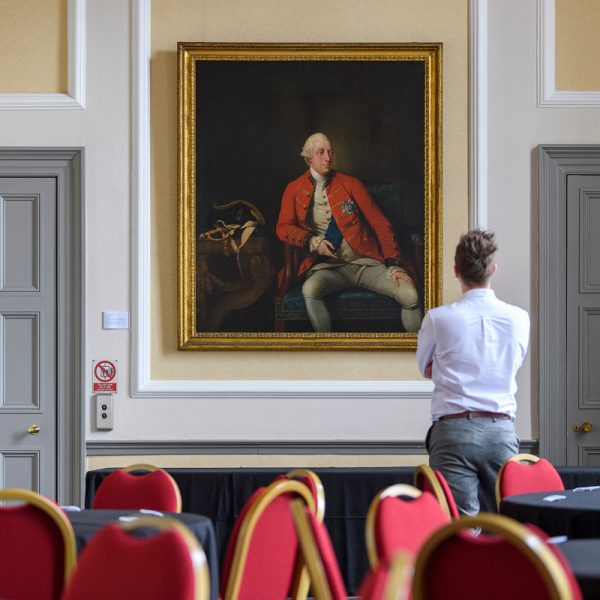
Edinburgh through the Founding Fellows
For more than 240 years, the legacy of the RSE’s Founding Fellows has helped influence Scotland’s intellectual and cultural life.
At its inception in 1783, the RSE included 179 original Fellows, many of whom were leading Enlightenment figures. The Fellowship included scientists, physicians, philosophers, historians, lawyers and other scholars, all united in their shared belief of advancing knowledge and improving Scottish society. Despite championing transformative thinking and new ideas, the Fellowship remained closed to women until 1949, when the first women Fellows were elected – 166 years after the Society’s establishment.
Over the centuries, the Fellowship has grown to encompass an even wider range of disciplines, professions and perspectives. Yet the legacy of many of these Founding Fellows remains visible across Edinburgh today, where their names and achievements are connected to the city’s streets, buildings, monuments and public spaces.
This historical route invites you to discover the Founding Fellows and how their ideas, achievements and public service are recognised across Edinburgh today.
Click the buttons to learn more about some of the RSE’s original Fellows:

The Royal Society of Edinburgh
The building at 22–24 George Street, now home to the Royal Society of Edinburgh, forms part of Edinburgh’s grand New Town and reflects the city’s 19th-century commercial ambition. Constructed in 1843, the building was commissioned by the Edinburgh Life Assurance Company, which had gradually acquired the site as part of its expansion. Architects William Burn and David Bryce were appointed to design a new headquarters for the company.
Although built primarily for the insurance company, the building was designed as a shared space. It accommodated both the company’s offices and leased premises for organisations, including the Edinburgh Subscription Library. This dual purpose shaped the architecture, with the façade carefully arranged to create two visually balanced entrances, reflecting the building’s unusual double role.
Behind its symmetrical exterior, however, the hierarchy of occupancy was clearly defined. The eastern entrance served the Edinburgh Life Assurance Company and opened into an impressive reception hall, where visitors were welcomed into a setting intended to convey authority and confidence. Roman Ionic columns framed the interior, leading toward a grand staircase and boardroom on the first floor. By contrast, tenants entered through the western porch at number 24, where access to upper floors was more functional and considerably less ornate, reflecting the social and institutional distinctions embedded within the building’s design.

The RSE moved into the building in 1909 after the National Galleries of Scotland Act 1906 required the Society to vacate rooms it had previously occupied in the Royal Institution on The Mound. Before the move, the building underwent alterations to suit its new purpose, including the conversion of the former reception hall into a library lined with bookshelves. The Society held its first meeting here on 1 March 1909, marking the beginning of a new chapter in its institutional history.
The wider site continued to evolve in the early 20th century. Adjacent properties at number 26 George Street and 33–35 Hanover Street were acquired by the Edinburgh Life Assurance Company and demolished in 1908 to make way for an enlarged headquarters. The replacement building, designed by Dick Peddie, adopted a grand Renaissance style that distinguished it from the surrounding Georgian streetscape.
The building’s façade was constructed from white Portland stone, a material rarely used in Edinburgh. Portland stone was also used in the building of St Paul’s Cathedral and Buckingham Palace.
One of its most striking features is the copper-roofed dome that crowns the corner of the building. Atop the dome stands a statue of Prudence, one of the classical virtues and a fitting symbol for both an insurance institution and a learned society. Representing wisdom, foresight, and careful judgement, Prudence reflects the values that have shaped the building’s history, from financial stewardship to scientific inquiry, and remains a distinctive feature of the RSE’s building today.

Dugald Stewart (1753–1828)
The Dugald Stewart Monument is one of Edinburgh’s most photographed landmarks, however the man it commemorates is far less well known.
Stewart was a leading figure of the Scottish Enlightenment. During his lifetime, he was considered one of Scotland’s foremost intellectuals, and was a founding Fellow of the Royal Society of Edinburgh. His approach to philosophical thinking greatly influenced writers such as Maria Edgeworth and Elizabeth Hamilton, who used his ideas to promote social progress for women and education for all classes.
As Professor of Moral Philosophy at the University of Edinburgh from 1785 to 1810, Stewart became one of the most influential thinkers of his age. However Dugald’s belief that Europeans were more genealogically “civilised” than other races contributed to racist narratives that were pervasive in the 18th and 19th century, particularly since he taught many students who would go on to hold elite careers in politics and imperial administration.
Following Stewart’s death in 1828, the RSE commissioned a monument in his honour, funded through public subscription. William Henry Playfair, one of Scotland’s most celebrated architects and a leading figure in Edinburgh’s neoclassical transformation, was commissioned to design the monument. Playfair is responsible for many of Edinburgh’s landmarks, including the unfinished National Monument (also on Calton Hill), Surgeons Hall, and the National Gallery of Scotland.
Completed in 1831, the monument was inspired by the Choragic Monument of Lysicrates in Athens, a structure dating from the 4th century BC. The choice of design reflected the city’s contemporary reputation as the “Athens of the North”, due to the city’s neoclassical architecture and intellectual outlook.
The monument’s fame today owes as much to its setting as to its history. Standing on the edge of Calton Hill, it frames one of the best views in Edinburgh. From here, the Scott Monument is visible on Princes Street, and Edinburgh Castle can be seen in the distance. Also visible in the foreground is the clock tower of the Balmoral Hotel, whose clock runs three minutes fast – a long-standing tradition intended to help travellers avoid missing their trains from nearby Waverley Station.
Adam Smith (1723–1790)
The Adam Smith statue can be found on the Royal Mile, in a prominent position outside St Giles’ Cathedral. Adam Smith was one of the most influential thinkers of the Scottish Enlightenment and is widely regarded as the father of modern economics. Best known for his 1776 work The Wealth of Nations, Smith transformed how people understood trade, labour, and economic exchange. His ideas on division of labour, productivity, and free trade laid much of the intellectual foundation for modern capitalism and continue to shape economic thought today.
Although remembered primarily as an economist, Smith’s work extended far beyond commerce. Earlier in his career, he published The Theory of Moral Sentiments, a major philosophical work examining ethics, sympathy, and human behaviour.

The statue was commissioned by the Adam Smith Institute and unveiled in 2008 as the first major public monument dedicated to Smith. Alexander Stoddart, known for his classical monumental style, was commissioned to design the sculpture. The monument was unveiled by Nobel Prize-winning economist Vernon L. Smith, marking renewed public recognition of Smith’s enduring global influence.
The monument is rich in symbolism. Smith is depicted in later life, during the years he spent in Edinburgh, where he worked and eventually died. Behind him stands a plough, representing the agrarian economy that preceded industrial capitalism, while a beehive at his side symbolises industry, productivity, and cooperation. Resting beneath his hand is a globe, reflecting the international reach of trade and the global influence of his ideas. His neckwear is modelled on that worn by Thomas Jefferson and his wig is based on one of George Washington’s.
The statue’s setting reinforces its meaning. Positioned beside the historic Mercat Cross, it stands within what was once the city’s commercial heart. Nearby is a statue of Smith’s friend and fellow philosopher David Hume, looking downhill to the Canongate (where Smith lived), towards the harbour of Leith (connecting Smith wide trade and commerce), and over to Fife, where Smith was born. Together, these surrounding landmarks connect Smith’s life, work, and ideas to the physical landscape of Scotland.

Benjamin Franklin (1706–1790)
The Mercat Cross on the Royal Mile has long been one of Edinburgh’s most important civic landmarks. Traditionally, it served as the site where public proclamations were read aloud by the town crier, ensuring that royal announcements, laws, and civic notices were communicated to the people. It was also associated with public punishment, including executions. The original cross dates to 1365, although it has been rebuilt and altered several times over the centuries following damage and reconstruction. In the eighteenth century, as the centre of the Scottish Enlightenment, Edinburgh attracted leading thinkers from across Europe and the Atlantic, including Benjamin Franklin, who visited Edinburgh several times.
Benjamin Franklin was a writer, scientist, diplomat, and political thinker, as well as one of the Founding Fathers of the United States and the first International Fellow of the Royal Society of Edinburgh. In Edinburgh, Franklin met many of the city’s scholars and philosophers who shaped Enlightenment thought – individuals who he called “men of genius”. It was said, only with slight exaggeration, that a person could stand at the Mercat Cross and “in half an hour, shake fifty men of genius by the hand.”
Franklin’s trips to Edinburgh greatly influenced his political thinking. During negotiations between Britain and the American colonies, he looked to the union between Scotland and England as a possible model for political settlement. Today, the Mercat Cross remains an important symbol of Edinburgh’s civic history. A unicorn sits atop the structure, accompanied by the Scottish flag, while decorative panels display the royal arms of Britain, Scotland, England, Ireland, Edinburgh, Leith, the Canongate, and the University of Edinburgh. It continues to stand as a reminder of the city’s political, social, and intellectual life across the centuries.

James Hutton (1726–1797)
James Hutton was a Scottish scientist whose ideas transformed the way we understand the Earth, laying the foundations for modern geology through his theory of “deep time” and the idea that the Earth is shaped by slow, continuous processes rather than sudden events.
Hutton was closely connected to the intellectual life of eighteenth-century Edinburgh and was a founding Fellow of the Royal Society of Edinburgh. He served on its first Council alongside leading figures such as Joseph Black, Adam Smith, and John Playfair, and worked in close collaboration with Black in leading the Society’s Physical Class. He also contributed to its publications committee, helping to shape the dissemination of scientific knowledge during the Scottish Enlightenment.
His interests extended far beyond geology. Hutton was a deeply interdisciplinary thinker whose work ranged across chemistry, agriculture, meteorology, philosophy, and linguistics. Many of his geological ideas were first presented through the Royal Society of Edinburgh and later published in its Transactions, most notably in his landmark ‘Theory of the Earth’, which introduced principles that would fundamentally reshape geological science. Hutton’s ideas were not always immediately understood or accepted, but they were later developed and clarified by his friend John Playfair, helping to establish his reputation as a central figure in modern scientific thought. His approach emphasised observation, evidence, and the gradual processes shaping the natural world; ideas that would later become central to geology as a discipline.

Despite the significance of his contributions, Hutton’s grave in Greyfriars Kirkyard remained unmarked for many years. It was only in 1947, on the 150th anniversary of his death, that a memorial plaque was installed by the then Lord Provost, Sir John Falconer, formally recognising him as the “Founder of Modern Geology.”
Today, the memorial in Greyfriars Kirkyard stands as a reminder of Hutton’s lasting influence on scientific thought and the wider intellectual culture of Enlightenment Edinburgh.

Joseph Black (1728–1799)
Joseph Black was one of the founding figures of modern chemistry and a pioneering scientist of the Scottish Enlightenment. Born in Bordeaux in 1728 to an Irish father and a Scottish mother, Black spent most of his working life in Scotland, where his careful experimental methods and clear teaching made him highly respected among both students and fellow scientists.

Black is best known for his discovery of carbon dioxide, which he referred to as “fixed air.” Through experiments on limestone, he demonstrated that heating it released a distinct gas, separate from ordinary air. He also showed that the same gas was produced when breathing. This discovery paved the way for later discoveries of gases such as hydrogen, nitrogen, and oxygen.
Black also made groundbreaking contributions to the understanding of heat, developing the concepts of latent and specific heat. He observed that when water reached boiling point, continued heating did not raise its temperature, but instead changed from liquid to steam. From this, he concluded that heat could be stored within a substance without producing a change in temperature, fundamentally altering scientific understanding of energy and heat transfer.
Black’s work had a direct influence on his friend James Watt, who made improvements to his steam engine based on Black’s explanation of latent heat. This connection between scientific theory and engineering innovation played a key role in advancing the Industrial Revolution.
In the 1790s, Black used Sylvan House in the Sciennes area as a summer residence. Built around 1740 for Joseph Williamson, the Town Clerk of Edinburgh, the white lime-harled house now carries a plaque commemorating Black’s contribution to science, marking his lasting connection to the city’s intellectual heritage.

Leading the way for change
Today, the RSE’s Fellowship brings together leading thinkers from a wide range of disciplines and backgrounds, but it was only in 1949, more than 160 years after the RSE’s founding, that the first women were finally elected as Fellows. Their election marked a turning point in the Society’s history, abolishing the previous exclusionary nomination process. They broke through barriers in science, education, and public service to take their place among Scotland’s most distinguished thinkers.
As the first women Fellows, they paved the way for generations who followed and helped shape the RSE as we know it today.

See Edinburgh through the Founding Fellows
To help you find out more about these Founding Fellows and their histories, we have pinned the locations on Google Maps associated with their legacies.
Learn more about the RSE’s history
-

-
The legacy of James Hutton
Read MoreA key figure of the Enlightenment, James Hutton’s groundbreaking ideas transformed what we thought we knew about the Earth.
-
Gaelic and the Fellowship: past and present
Read MoreAcross our long history, Gaelic-speaking Fellows and Gaelic scholars have made considerable contributions to the RSE’s mission.